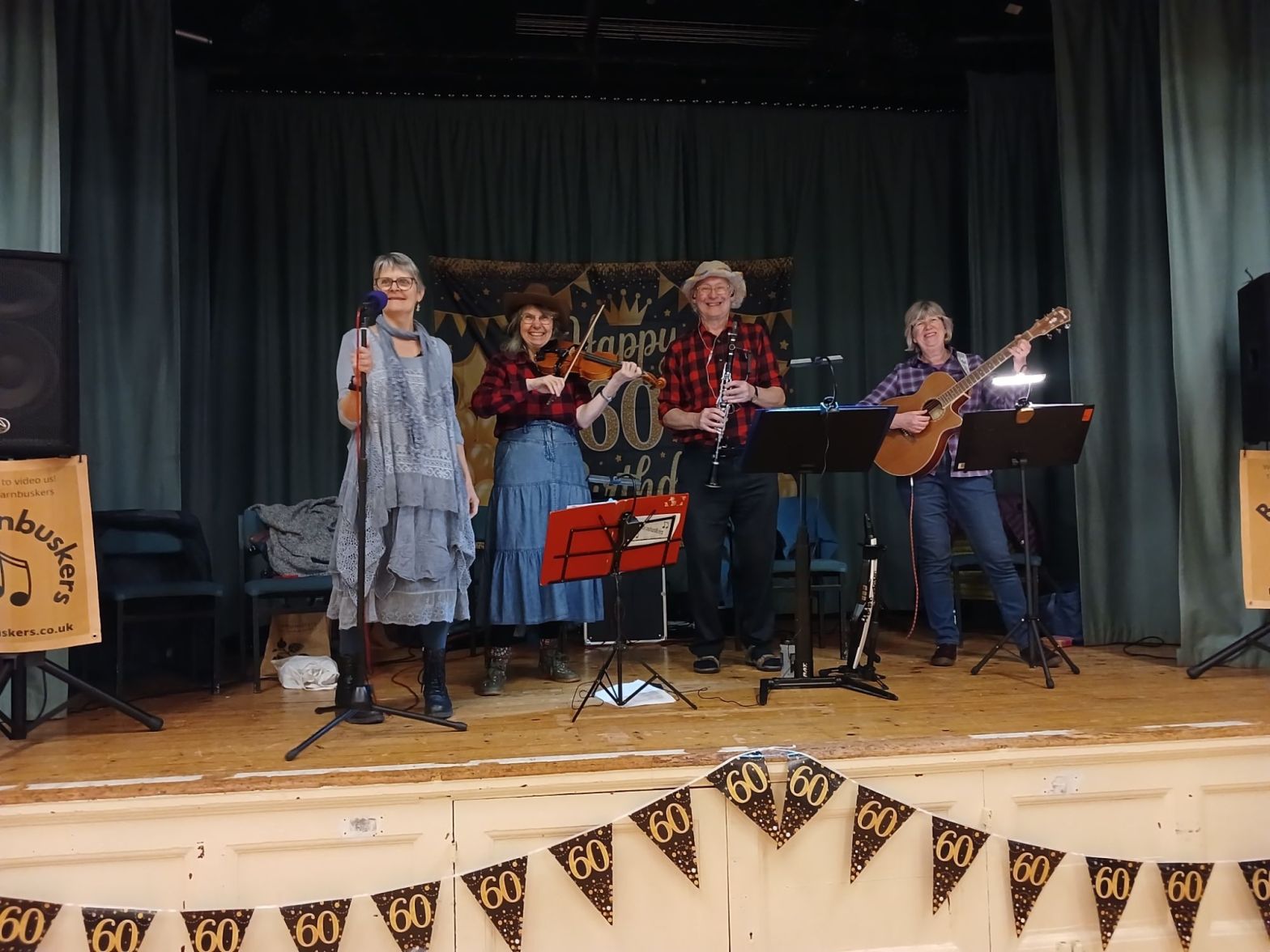
You might be thinking of holding a special event with music and dancing and want everyone to enjoy themselves but what sort of band to book? Perhaps it’s for a birthday party or a wedding where there are likely to be a mix of generations from toddlers to pensioners with different dancing preferences. Or you might be organising an event for a community centre or village hall and want people of all ages and abilities to be able to join in. You’ve heard of country dances, ceilidhs and barn dances but are not sure how they work. This Barnbuskers Ceilidh Barn Dance Band article is for you and explains why country dancing at a ceilidh or barn dance, whichever band you choose, might be just what you are looking for!
The Basic definition
Simply speaking, a country dance / ceilidh / barn dance is a very social dance event common in places like England, Scotland, and Ireland. People gather in a hall, barn or even in the open air usually with a live band and a caller (a person who explains the moves). You don’t usually need to know the dances beforehand because the caller teaches the dances as you go. It’s the sort of fun where everyone can join in, often with lots of laughter and informality. Basically, almost anyone can do the dances which is why people have been enjoying this form of dancing for hundreds of years.
Why is the band usually live? Well because a live and professional band can expertly adapt the speed of the music to the agility of the dancers making it suitable for all abilities. Recorded music is an option in some circumstances but recorded music is usually better for regular country dance meetups where the ability of the dancers is known or can be anticipated eg. dance clubs or classes (eg Judy’s Ceilidh Dance Exercise Classes for those local to Watchet or Minehead in West Somerset)
How does the evening start?
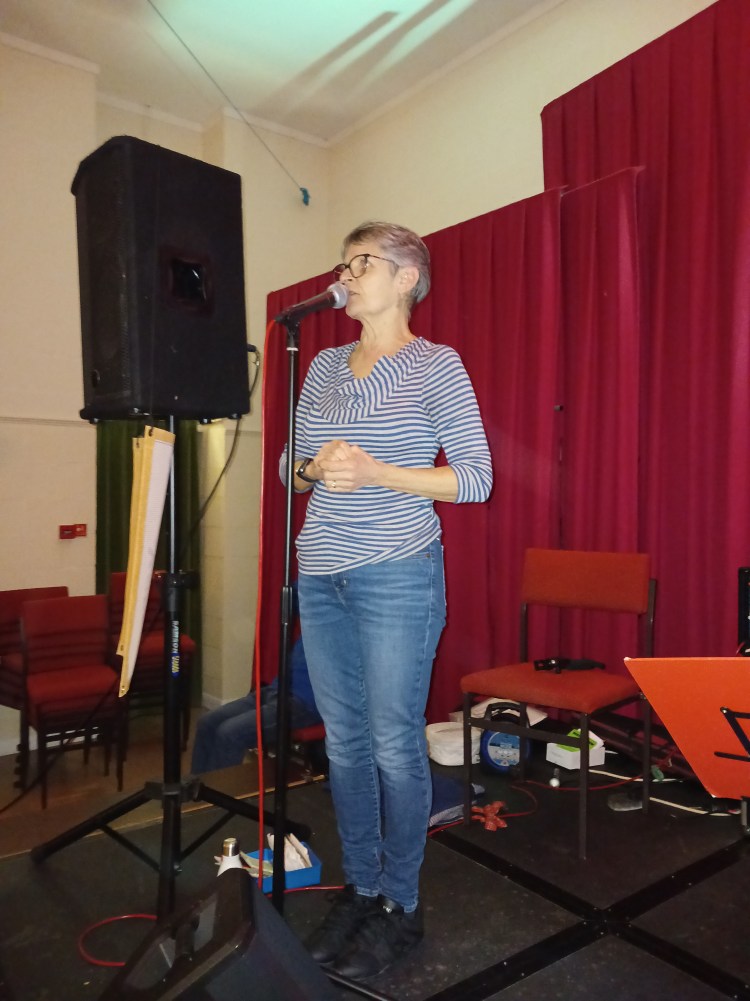
The band will turn up with dance caller perhaps an hour before the dancing is due to start so they can get set up on the stage or performance area of the hall where there is a power supply. For very small venues, the band might be acoustic but for more substantial gatherings, the band will need amplification and powerful electronic equipment. When people are having fun, they tend to laugh, whoop and with lots of people on the dance floor, substantial amplification is usually needed for the dancers to hear the music and caller. Bridget (photo below) is one of Barnbuskers favourite callers.
What happens during the event
- Live music starts
The band (often a mix of fiddle, accordion, guitar and wind instruments) plays a couple of traditional folk tunes to get everyone in the mood. - The caller invites dancers onto the dance floor
Once there are enough dancers on the dance floor, the caller arranges them into lines, circles, or squares called sets, usually with partners, and walks everyone through the steps of the dance. Callers have a wide range of dances in their repertoire and will match the particular dance to the number of dancers on the floor and their abilities. Country dance callers are highly skilled, experienced and well practised in ensuring everyone has fun as they learn the steps. This often only takes a few minutes because the dance moves are usually very easy. - Music begins and the dance repeats
The sequence of steps repeats many times so everyone can learn it while moving. Walking in time with the music is fine and many do, skipping and galloping is always available for partners that can. - Partners and positions rotate
In many dances you move along the set and eventually dance briefly with different people so it’s extremely social.
The atmosphere is relaxed, lively, and often a bit chaotic in a fun way. Here are some example dance moves the caller might explain.
1. Circle Left / Circle Right
Formation: everyone in a small circle holding hands.
Steps:
- Hold hands with people on either side.
- Walk or skip sideways around the circle.
- Move left for “circle left” or right for “circle right”.
- Usually 8 steps in time to the music.
Purpose: warms everyone up and keeps groups together.
2. Do-si-do
Formation: face your partner.
Steps:
- Walk forward past your partner’s right shoulder.
- Move behind them.
- Walk backwards past their left shoulder.
- Return to your original place.
You never actually turn to face them while moving – it’s like orbiting around them.
3. Promenade
Formation: side by side with your partner
Steps:
- Partner stands beside you.
- You hold inside hands (or link arms).
- Walk forward around the room or around a circle of couples.
This move travels around the dance floor.
4. Swing
Probably the most famous ceilidh move. There are lots of options for swinging your partner. Here is the easiest.
Steps:
- Face your partner.
- Join crossed over hands.
- Lean back slightly.
- Spin together clockwise.
5. Strip the Willow (a classic ceilidh dance)
A fast spinning dance from Scotland.
How it works:
- Two long lines face each other.
- The top couple begins.
- They swing each person down the line one by one.
- Each swing lasts a few seconds before moving to the next dancer.
It becomes faster and more chaotic as the music speeds up.
6. The Gay Gordons (another famous dance)
Also from Scotland.
Basic pattern:
- Couples march forward for 4 steps.
- Both turn round and march backwards for 4 steps.
- Repeat.
- Spin.
What it feels like
- lots of laughing and mistakes
- live energetic music
- people constantly changing partners and places
- beginners mixing with experienced dancers
Unlike formal ballroom dancing, the goal is fun and community rather than perfection. Callers might alter standard dances to suit those present and ensure they have a good time.
Finally
Throughout the evening there will probably be around eight to ten dances in total, but the caller will judge what is best in discussion with the host. Sometimes the caller might invite the band to play a tune to give the dancers a rest before the next dance.
Half way through the evening, there is often a break for the dancers and band to have a rest, have some refreshment or food, chat and socialise. (Tip: if it’s a birthday party, now is a good time to bring out the cake and sing happy birthday!)
That’s it! We hope it helps!
Of course, if you decide to hold your country dancing ceilidh or barn dance in Devon or Somerset, Barnbuskers Ceilidh Barn Dance Band would love to hear from you. We can offer a duo of musicians with caller, three musicians with caller or a big band with four musicians and caller, whatever suits you. Simply message Judy, Barnbuskers Band leader and organiser (photo below), on Barnbuskers website contact page with your requirements.
Whether it’s for your private party or at a public ceilidh or barn dancing event, Barnbuskers looks forward to hearing from you. (Tip: you can follow us on Barnbuskers social media too). Judy, who is also an experienced dance caller will be happy to answer any further questions you have.
Bye for now

 Barnbuskers